Semaglutide in Metabolic Research: Mechanism, Half-Life, and Reconstitution
A reference overview of the most-studied GLP-1 receptor agonist in current metabolic research.
Semaglutide is a synthetic 31-amino acid analog of glucagon-like peptide-1 (GLP-1), engineered for extended in-vivo stability. It has become the de-facto reference compound in metabolic research literature published since 2018, used both as a study molecule in its own right and as the benchmark against which newer GLP-1 family analogs are compared.
This article covers what researchers typically need to know before working with semaglutide: its molecular design choices, pharmacokinetic profile, common reconstitution practice, and considerations for storage and handling. It does not constitute medical advice and is not a dosing recommendation for human or veterinary use.
Molecular design
The native GLP-1 (7-37) peptide has a plasma half-life of roughly two minutes due to rapid degradation by the enzyme dipeptidyl peptidase-4 (DPP-4). Semaglutide retains GLP-1 receptor agonism while resisting that degradation through three structural modifications: an alanine-to-α-aminoisobutyric-acid substitution at position 8 (DPP-4 resistance), a lysine substitution at position 34, and an attached C18 fatty diacid moiety on the lysine at position 26.
The fatty diacid is connected via a γ-glutamic-acid-2×OEG linker and binds tightly to serum albumin. Albumin acts as a slow-release reservoir, dramatically extending the peptide's plasma half-life to approximately one week in human pharmacokinetic studies. This is the structural feature that enables once-weekly dosing protocols in research models.
Pharmacokinetics in research models
Time-to-peak plasma concentration after subcutaneous administration is approximately 24-48 hours in reported animal studies. Steady-state plasma concentrations are typically reached after 4-5 weeks of weekly administration. Bioavailability is high for the subcutaneous route; oral semaglutide formulations exist but require a permeation enhancer and show much lower bioavailability.
Researchers studying acute pharmacology rather than steady-state effects sometimes use higher single doses to compress the timeline. The molecule's slow elimination profile means residual signal can persist for several weeks after the last dose, which matters for crossover study designs.
Common research applications
Semaglutide is the standard reference in research on glucose-stimulated insulin secretion, including comparative studies of GLP-1 receptor agonism vs DPP-4 inhibition and vs newer GLP-1 family compounds. It is also widely used in satiety pathway research, gastric emptying kinetics, and central nervous system reward signaling, since GLP-1 receptors are expressed in regions including the nucleus tractus solitarius and arcuate nucleus.
More recent published work includes its use as a tool compound in studies of inflammation markers, hepatic lipid metabolism, and cardiovascular endpoints in pre-clinical animal models. The breadth of research applications is why semaglutide is the most-cited GLP-1 analog in publications since 2020.
Reconstitution and storage
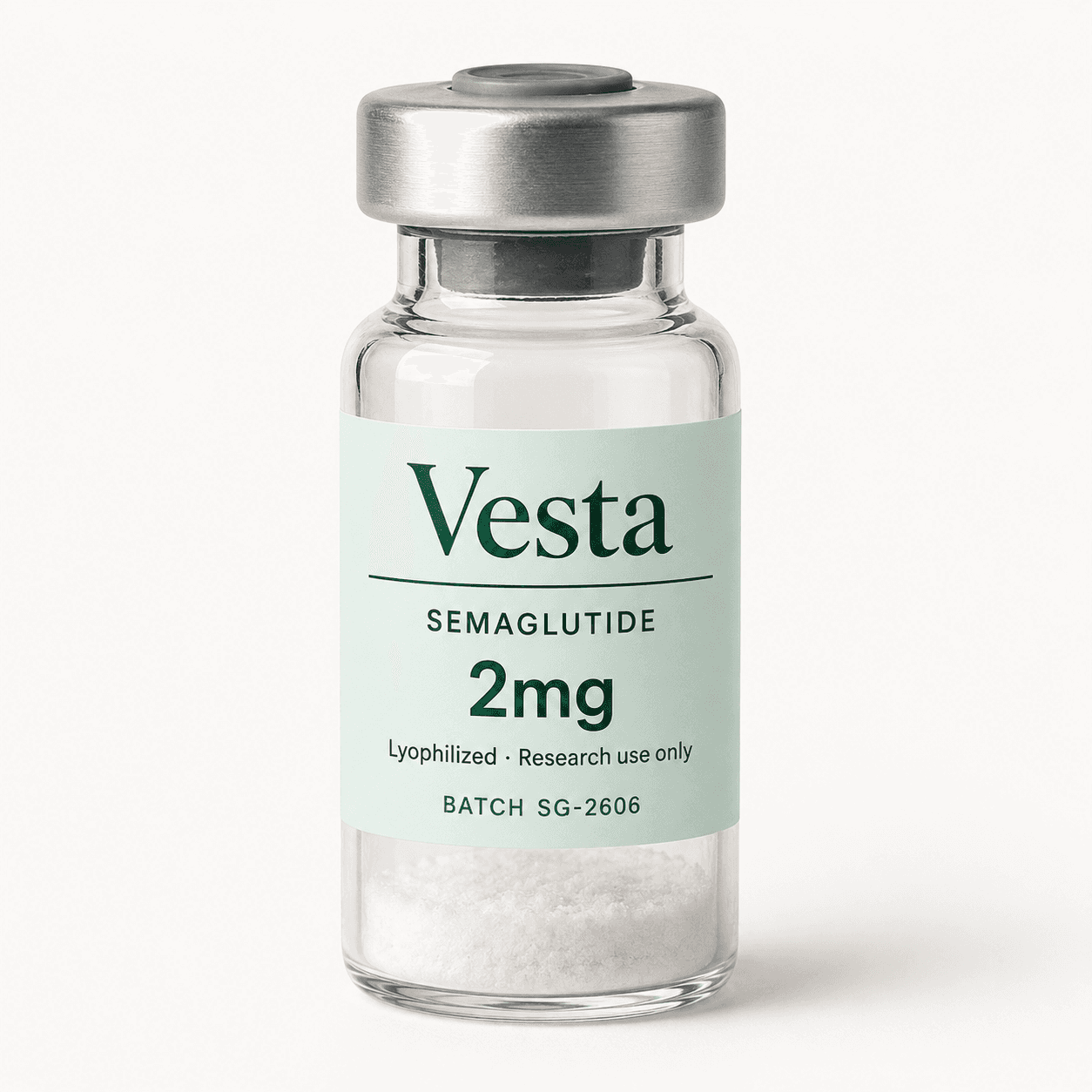
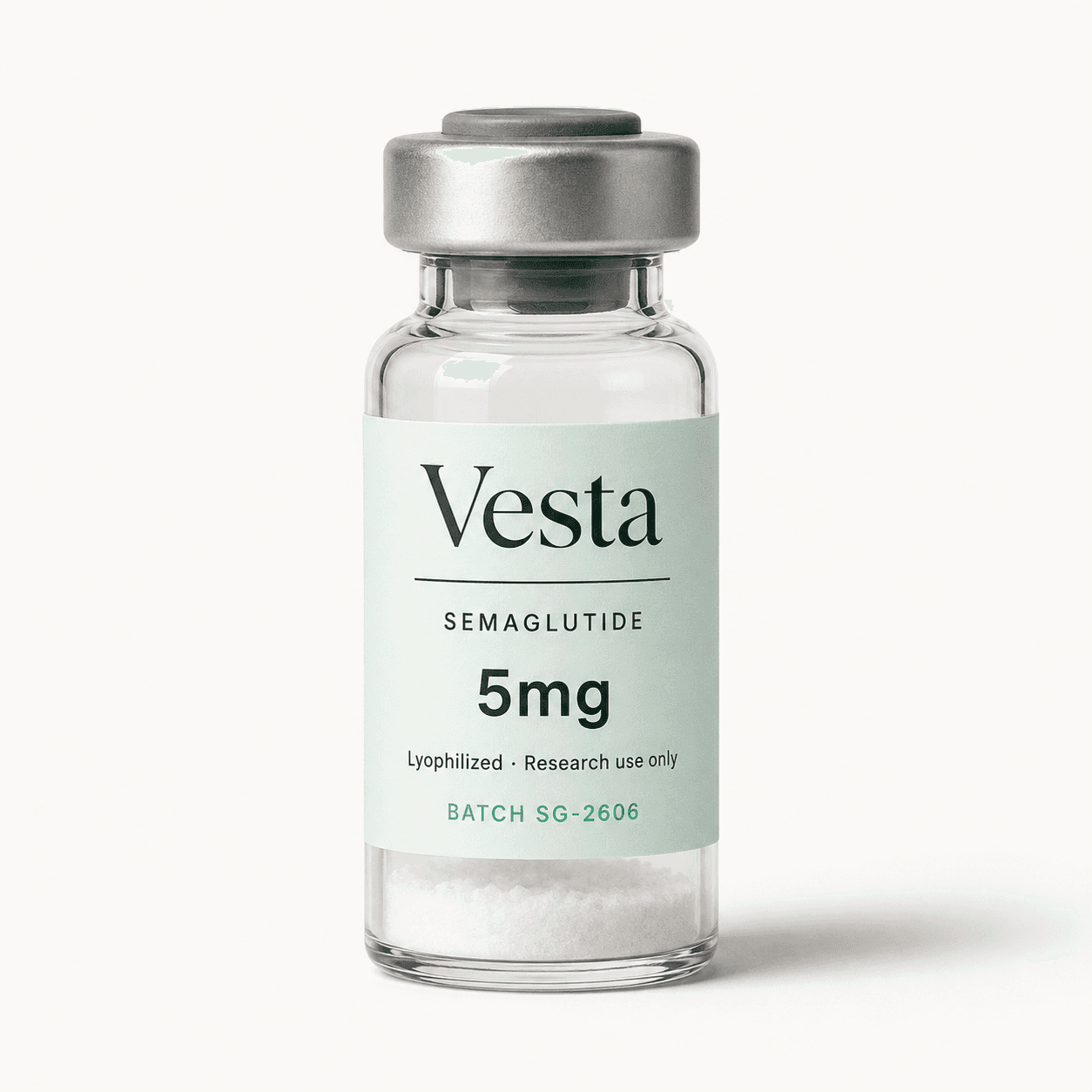
Vesta supplies semaglutide as a lyophilized white powder, sterile-filtered before lyophilization and sealed in glass vials under nitrogen. The standard reconstitution range in published protocols is 1-3 mg/mL using sterile bacteriostatic water (water containing 0.9% benzyl alcohol as a preservative).
Reconstituted material is typically stable for up to eight weeks under refrigeration at 2-8°C, provided the stopper has not been pierced more than the manufacturer's specified number of times. Repeated freeze-thaw cycles should be avoided. Lyophilized product is best stored at -20°C until reconstitution.
Vesta's batch QC for semaglutide
Every Vesta semaglutide batch is verified by reverse-phase HPLC at 220 nm with a 99.0% main-peak cutoff, confirmed by LC-MS for molecular weight match within ±0.5 Da of the theoretical 4113.6 g/mol, screened for endotoxin by LAL assay, and finally re-verified by a US-based third-party analytical lab. The COA for the actual batch in your shipment is included as a downloadable PDF with the order — not a sample report.