GHK-Cu in Skin and Collagen Research
The copper-binding tripeptide that has been studied in fibroblast biology, wound healing, and hair-follicle models for forty years.
GHK (glycyl-L-histidyl-L-lysine) is a tripeptide that occurs naturally in plasma, saliva, and urine. Its concentration declines with age — from approximately 200 ng/mL in young adults to around 80 ng/mL by age 60 in published surveys. The copper(II)-complexed form (GHK-Cu) is the bioactive species used in most published research, and its high affinity for copper makes it a useful tool for studying copper-dependent biology.
Mechanism overview
GHK-Cu's effects in research models are mediated by multiple parallel mechanisms. The peptide modulates expression of genes involved in extracellular matrix production (collagen, elastin, glycosaminoglycans) in dermal fibroblasts. It also influences inflammatory cytokine production, angiogenesis markers (VEGF, FGF), and antioxidant enzyme expression.
The copper(II) center is essential to many of these effects. Researchers running protocols sensitive to free copper or to chelation states should be aware that buffer composition and pH influence the GHK-Cu complex stability.
Published research applications
Dermal fibroblast collagen production studies form the largest body of GHK-Cu research, with consistent findings of increased collagen I and III synthesis after GHK-Cu treatment in cultured cells. Wound healing models in rodents show accelerated re-epithelialization and reduced scar formation, attributed to combined collagen, angiogenesis, and anti-inflammatory effects.
Hair-follicle research using GHK-Cu is less mature but actively expanding, with reports of follicle-cycle modulation and increased follicle density in animal models. Topical and injectable routes both appear in published protocols.
Reconstitution and handling
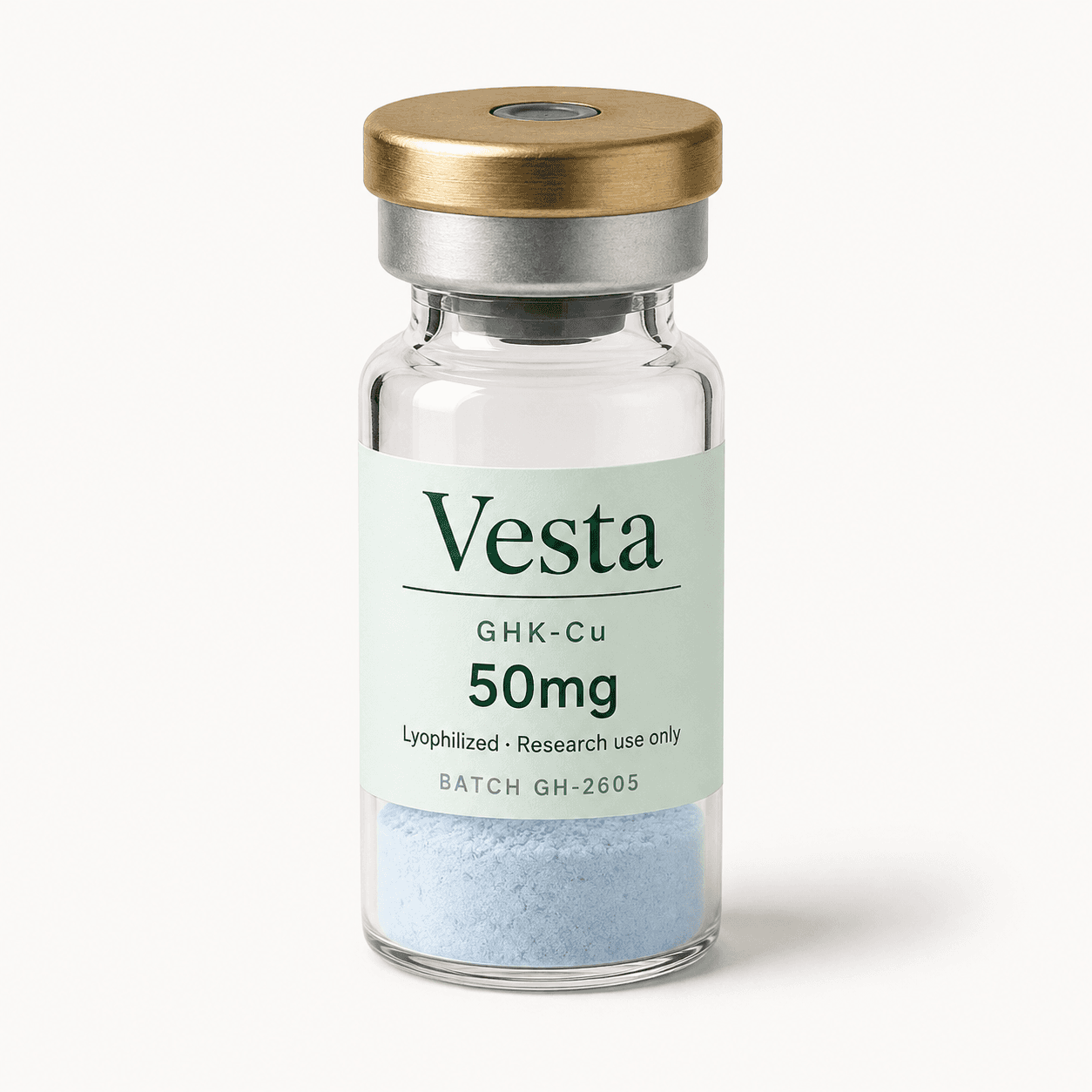
Vesta supplies GHK-Cu as the pre-formed copper complex in lyophilized form. The lyophilized cake has a characteristic light blue tint from the copper(II); reconstituted solutions take on a deeper blue color. Standard reconstitution is at 5-10 mg/mL in sterile water.
The copper complex is more stable than free GHK at neutral pH. Avoid acidic buffers that can dissociate the copper. Stable for several weeks refrigerated; longer storage is best in lyophilized form at -20°C.
Pairing in dermal research
GHK-Cu is often combined with other peptides in dermal research protocols — KPV for anti-inflammatory effects, TB-500 for cell migration, or other matrix-modulating compounds. Vesta's KLOW stack bundles GHK-Cu 50mg with KPV, TB-500, and BPC-157 specifically for multi-pathway dermal and tissue repair research designs.